Test Zone




It has never been easier and more important for small and medium-sized businesses to embark on their automation journey. Given the shortage of specialists, rising costs, and fierce competition, waiting often presents the riskiest option. automatica is the perfect trade fair to visit for guidance on successfully taking the first steps in automation.
Automation is no longer just for large groups of companies. It has evolved into one of the most important strategic priorities for SMEs and craft undertakings. Thanks to groundbreaking technological advances in fields such as artificial intelligence, low-code or no-code software, cobots, and robot-as-a-service, the barriers to entry are now significantly lower and the associated outlay is much less than just a few years ago.
Test Zone
automatica Forum
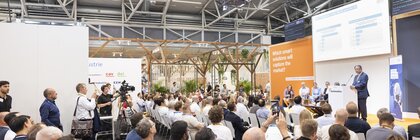
The first steps on any journey towards automated production should focus on analysis, standardization, and selecting a low-risk pilot project. A simple, monotonous, or unergonomic repetitive task with low complexity is the perfect candidate for an initial automation project. Typical use cases include packaging, palletizing, simple pick-and-place operations, sorting, loading and unloading machines, etc.
Important: Start with a clearly defined pilot project instead of trying to convert the entire workshop in one go. A small quantifiable success builds trust and expertise within the company. Also: It is important to involve the employees in an effort to make them aware of the benefits automation brings: less monotonous tasks, new and exciting work responsibilities, and opportunities to create greater value.
Integration with higher-level systems, if desired, is now easily achieved with modern software architectures, open interfaces, and, of course, AI. Experience it live and up close at automatica in Munich – the driving force for your production facility’s smart transformation.
The era of complex programming is over: Modern automation solutions for entry-level use cases consistently rely on intuitive no-code and low-code configuration. Many modern robots can be integrated manually and deployed very quickly thanks to innovative teaching methods. Systems using integrated artificial intelligence (AI) to continuously learn during regular operation while independently optimizing their motion paths take this yet another step further.
automatica is your perfect opportunity to experience such visionary plug and play solutions for quick and easy commissioning live and up close. In addition, next-gen concepts such as voice and gesture control demonstrate just how easy human-robot interaction can be.
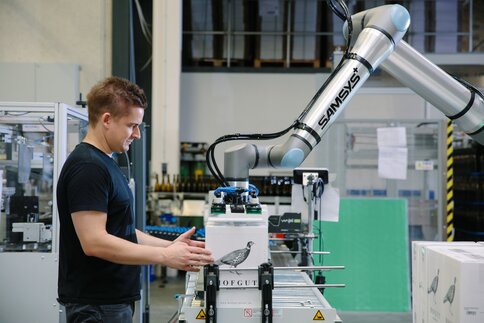
Efforts to establish an initial automation solution with maximum flexibility often lead to the deployment of cobots. Their integrated sensor technology enables these collaborative robots to interact with people directly – without any barriers or safety fences. This physical flexibility also unlocks great ease of use: Complex programming is replaced by intuitive teaching through manual guidance in many cases. This enables even employees without any IT background to operate and set up the robot for new tasks in no time.
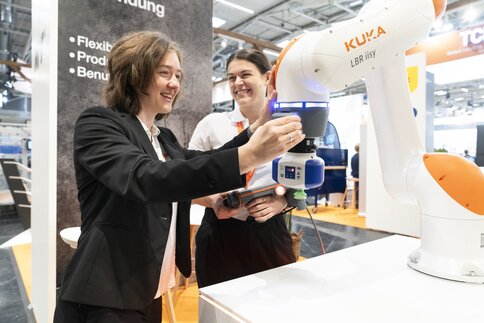
What that means for companies: quick setup, maximum flexibility in switching between product variants, and immediate employee relief from monotonous work steps. Visit automatica to learn how flexible the latest cobots really are and to how to economically automate tasks down to a batch size of one.
Tight investment budgets are not a barrier to adopting modern automation; they just require economically sound planning. Standardized, modular systems and equipment from renowned manufacturers are scalable and can be easily expanded as needed, thus ensuring a cost-effective start in the realm of low-cost automation.
Getting started requires even less liquidity if you eliminate the capital risk by opting for a Robot-as-a-Service (RaaS) model. This just means that you will rent robots instead of buying them – a model promoted by many exhibitors at automatica. These flexible rental and subscription models convert large one-time investments into predictable monthly operating expenses. The highlight: RaaS comes as an all-inclusive carefree package. The service provider assumes full responsibility for system reliability and availability – from maintenance and software updates all the way to unplanned downtime. For SMEs, this means state-of-the-art robotics on the production floor at maximum financial flexibility and zero risk.
No one has to figure out automation on their own: There are numerous initiatives, networks, and government-funded projects. The path to automation often begins with a small-scale pilot project in cooperation with universities and research institutes providing scientific guidance and real-world support to your company.
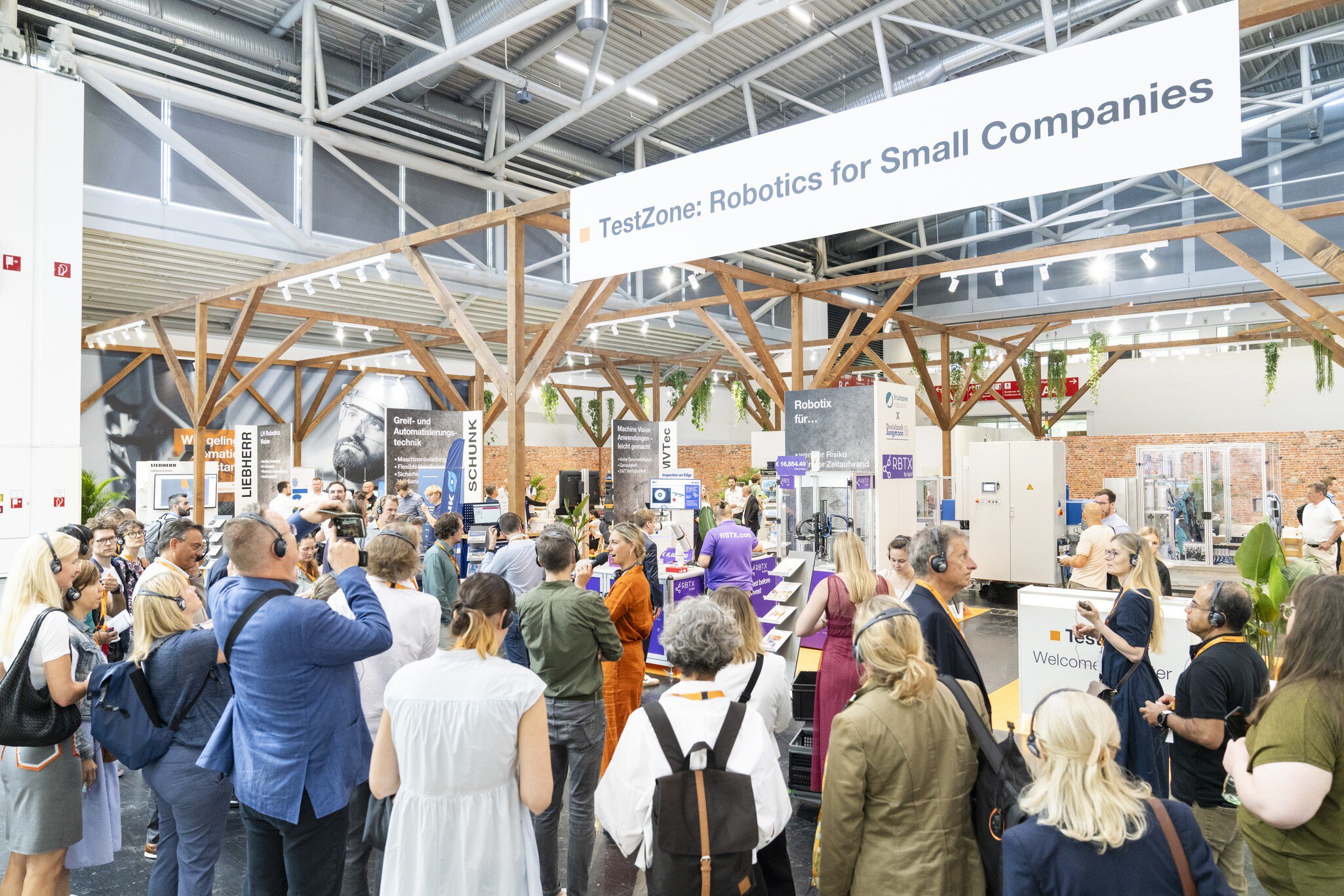
automatica is the perfect event to facilitate such efforts. It is an opportunity for you to see for yourself how easy robot deployment has become. Special newcomer formats such as bespoke SME forums, guided tours, and independent consultation corners facilitate quick orientation. And then experienced manufacturers, system integrators, and service providers are available to answer any questions on that all-important initial automation project.
Physical AI drastically lowers the barriers to entry in automation. While automation projects of the past frequently failed due to huge investments and great complexity, the situation has been revolutionized by modern AI and intuitive robotic systems such as cobots: Today’s machines can be taught just by showing them (teaching by demonstration) or via graphical user interfaces. This significantly reduces the programming effort.
AI-powered vision also enables robots to dynamically adapt to changing environments or unstructured components. This makes automation solutions extremely flexible while reducing their deployment lead time and lowering their price point enough to become attractive options for SMEs and craft undertakings with no in-house programming expertise. This drastically lowers the barriers to investment and makes automation a straightforward economical success factor boosting productivity.
What if work were no longer work? What if monotonous tasks became entertaining? What if back-breaking labor were reduced to a voice command? automatica 2025 will reveal just how close vision and reality have already come. There, exhibitors from around the world will demonstrate how robots, cobots, and humanoids interact with people, support them, and generate new, exciting work opportunities.
Education & Young Talent
The best way to get started is a phased approach that minimizes risk. This involves selecting a simple, stable routine process with moderate requirements and defining its parameters such as cycle time and quality criteria. The manufacturer's online configuration tool is then used to set up a single pilot system that includes a safety concept. If this pilot achieves the proof-of-process in a real-world setting, a standardized template with bills of materials and acceptance plans will be created as a basis for the secure final rollout. The advantage: This procedure minimizes investment risk and complexity while creating a scalable foundation for future projects.
A cobot, i.e. a collaborative robot, is specifically designed to work directly and side by side with humans in a shared workspace. While traditional industrial robots operate in a separate space and independently of humans, cobots act as flexible assistants supporting humans in performing monotonous, physically strenuous, or unergonomic tasks.
Not necessarily. Particularly the entry-level automation segment offers robots specifically designed for easy ‘training’. They are also readily adapted to changing requirements, meaning they do not require any programming. Depending on the system, this may also be powered by AI.
Simple robot-based automation usually pays for itself within one to four years, and typical initial investments range from 50,000 to more than 100,000 euros. It is an investment with the potential to significantly reduce production costs. Cobots can have even shorter amortization periods, especially when used in multiple shifts. Apart from the financial aspect, the investment also helps tackle the shortage of specialists. It enables highly paid specialists to create greater value.
For hands-on testing and comparison of robots from different manufacturers before purchasing, SMEs can take advantage of independent robotics labs, digital marketplaces and their affiliated testing centers, universities and research institutions, as well as specialized trade shows – most notably automatica, the world’s largest exhibition of automation technology.