

PDF download
194023
Press release
German economy calls for faster humanoid robotics adoption
June 24, 2026
- 82 % consider humanoid robots drivers of future innovation
- AI and robotics as pivotal enablers of competitiveness and industrial innovation
- (Physical) AI to be key topic at automatica 2027
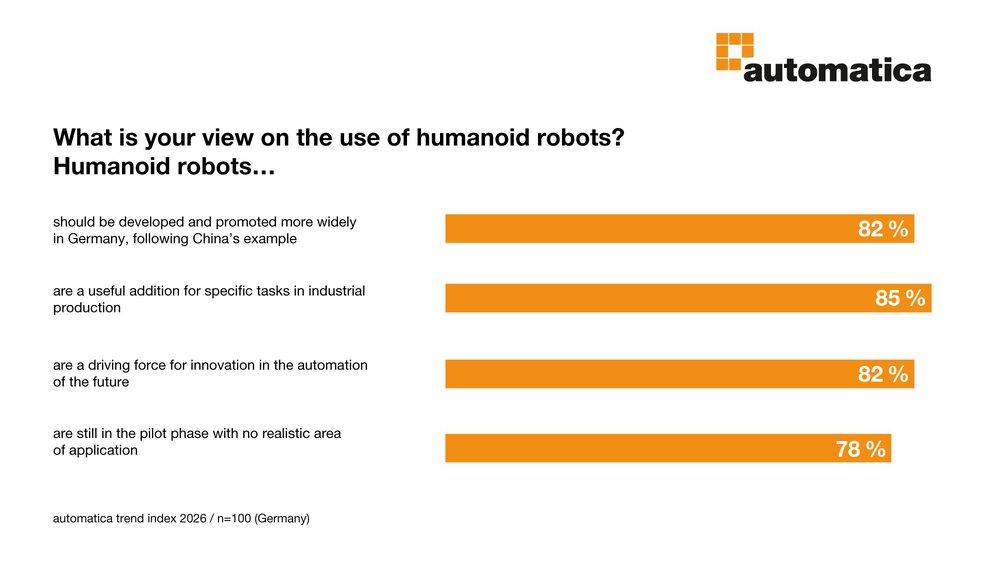
A vast majority of decision-makers from the German industry considers humanoid robots drivers of future innovation in automation. 82 percent of respondents think that Germany should increase subsidies for humanoid robotics development the way China has. This is a finding of the 2026 automatica Trend Index. The survey was commissioned by automatica and a total of 100 German specialists and executives responsible for taking decisions on the adoption of robotics and automation in their respective companies participated.
“China has been consistently pursuing a national robotics strategy for years to systematically capitalize on the opportunities offered by modern automation”, says Patrick Schwarzkopf, Managing Director of the VDMA Robotics + Automation Association. “Beijing’s latest five-year plan places smart robotics at the very center of its development goals. Thus, they are ushering in a new era of humanoid robots with the goal of developing an embodied intelligence integrating AI software with physical robotics. Plans are in place for entirely new practical AI applications promoting industrial and commercial automation.”
Robotics and automation crucial for competitiveness
Smart robotics is considered a pivotal field of innovation in Germany, too: 78 percent of respondents believe that AI and robotics deployment is indispensable for keeping the German industry competitive. The automatica Trend Index also found that humanoid robots already play an important role in industrial production (85 %)—even though 68 percent of the respondents still primarily operate pilot projects without large-scale adoption.
Exhibition Director Anja Schneider comments: “Humanoid robotics is a particularly striking example of physical AI as it presents AI in human-like form as it interacts with the physical world. We can already say that physical AI and humanoid robotics will be the key topics at automatica 2027.”
A solid foundation: Germany in the top 3
Humanoid platforms are illustrative of future automation use cases requiring the combined expertise of various disciplines. In this framework, traditional mechanical engineering know-how joins forces with modern systems technology, sensor technology, and AI-based software development. The so-called physical AI deployed here requires realistic and properly processed production data acquired by sensors. Germany is in a great position to adopt this technology due to its advanced production facilities. With 449 installed industrial robots per 10,000 employees, Germany has one of the greatest robot densities in the world and, according to the International Federation of Robotics (IFR), takes third place right behind South Korea and Singapore.
Downloads
Belonging images

Matthias Glötzner
- PR Manager
+49 89 949-21483
+49 89 949-21483Write an e-mail
Write an e-mail