

How physical AI unlocks next-level production

Industrial automation is not just on the brink of a paradigm shift—the shift is in full swing. Physical AI changes everything and determines the economy, efficiency, and user-friendliness of future robots and plants. The timing of corporate investment decisions will determine whether and how companies will be able to compete in increasingly challenging markets.
Physical AI refers to the integration of artificial intelligence with physical systems. In other words: an intelligence enabling machines and robots to comprehend their environment and to use this understanding to act independently. This leads to systems that can flexibly adjust to changing circumstances without any need for reprogramming. And it unlocks countless fields of application in industrial production. But how evolved is this new technology—what challenges and how much potential is it associated with? We provide an overview!
The AI brain and its capabilities
Whether physical AI works in practice largely depends on two factors: sensor technology and computing power. That's because an AI system needs inconceivable compute capacity to derive a gripping decision from a high-resolution camera image. In the industry, this capacity is quantified anywhere from a few to a thousand TOPS (Tera Operations Per Second). That's an incredible 1,000 trillion operations per second.
You might also be interested in:
For more information on sensors for Physical AI, see the article: “Sensor technology: the foundation of physical AI”
Tobias Rietzler, CEO of AI robotics pioneer robominds, explains an additional aspect: “Latency is another major challenge associated with the more general industrial AI systems. The neural network has millions of steps and considers millions of parameters. This needs to happen within a fraction of a second in order to ensure real-time communication with the robot—every single millisecond counts. That's why we have our proprietary NEUROS operating system that closes the gap between statistical AI models and real-time robot communication. That is the need of the hour in physical AI.”
Specialized AI accelerators currently play an important role in this context. NVIDIA's Jetson platform complemented by cloud-based inference for compute-intensive pre-processing steps is a popular choice in low-latency edge AI robotics right now.
Off-the-shelf AI robots vs. individual solutions
Today's AI models are usually trained specifically for the objects and process steps involved, sensor and actuator technology is aligned, and AI functionality is integrated with existing control architectures.
However, some standardized approaches to common tasks such as gripping and inserting identical components or sorting according to pre-defined characteristics have emerged. This is facilitated by general AI computer systems connected to standard industrial robots, making them “smart” and enabling them to use the corresponding skills independently—even without individual training in many cases.
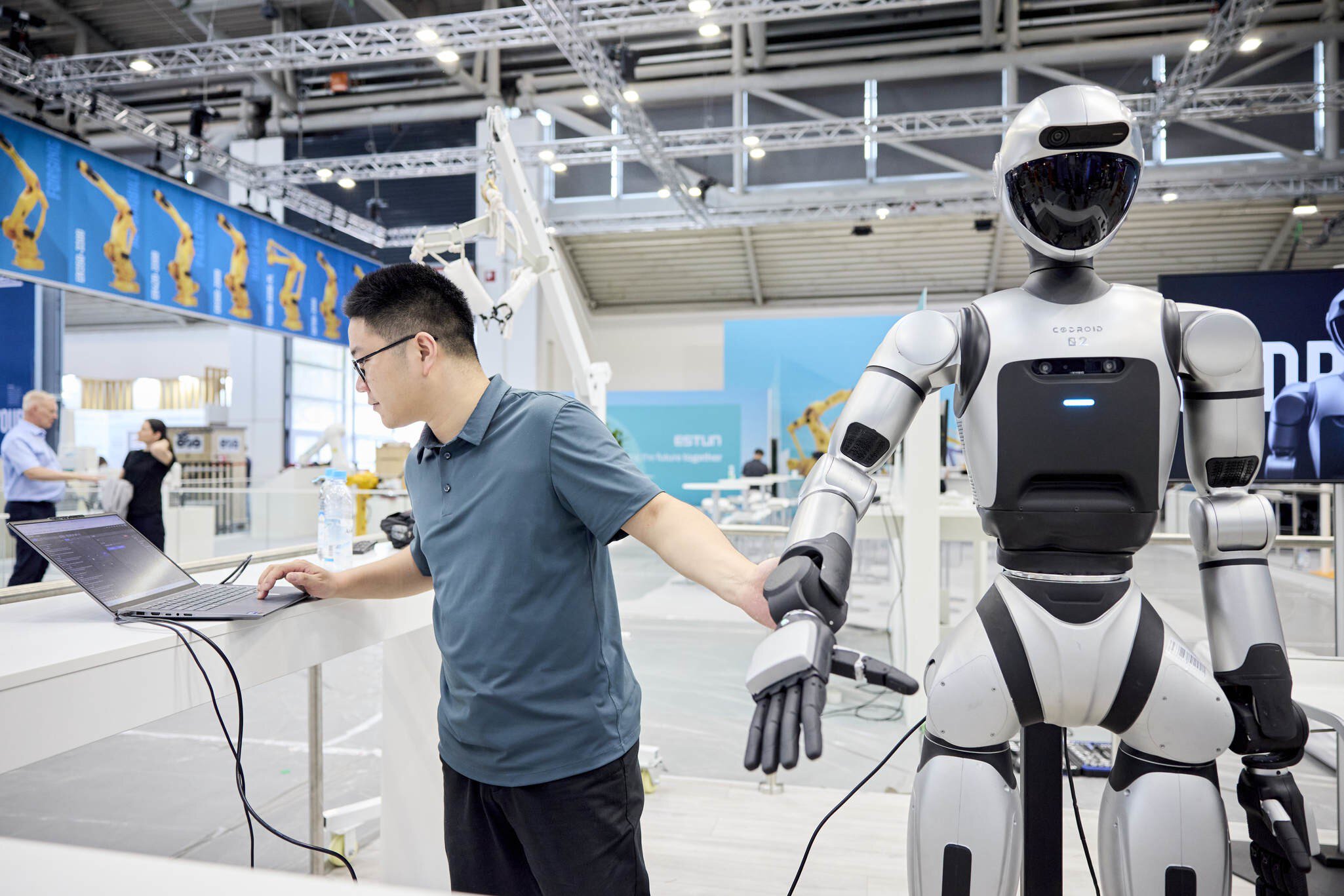
How robot manufacturers react to the physical AI hype
Physical AI is more than just a brief fad—some manufacturers have even made it their strategic priority. The Augsburg-based robotics group KUKA and their 2025 physical AI research and development investment of far more than 200 million Euros is an example of that. The company presents their KUKA Automation Management Platform (KUKA AMP)—an open software platform developed to set new benchmarks.
Melonee Wise, renowned US robotics pioneer and new Chief Software & AI Product Officer at Kuka: “KUKA AMP is going to be our foundational technology to orchestrate robots, fleets, cells, and digital twins across factories, warehouses, and commercial environments. The platform links the physical with the digital world and enables intent-based robotics, smart fleet control, and scalable AI‑driven automation—with unprecedented speed.”
The AI transformation at ABB Robotics takes place under an entirely new ownership structure. In October 2025, ABB Group announced that they will sell their robotics division to the Japanese SoftBank Group for 5,375 billion US dollars. SoftBank CEO Masayoshi Son clearly stated his plans: „SoftBank's next frontier is Physical AI.” With ABB Robotics, the group acquired one of the world's strongest industrial robotics brands to substantiate their intentions.
ABB Robotics also announced an extensive partnership with NVIDIA in March 2026. It led to the development of RobotStudio HyperReality—a virtual environment enabling the simulation of robot cells in conditions matching the physical reality up to 99 %. The software has the potential to significantly lower development costs by eliminating the need for prototyping and to speed up development cycles by up to 50 percent. The market launch is scheduled for the second half of 2026.
Physical AI in practice: current real-world use cases
At automatica 2025, Agile Robots proved that physical AI already has real-world use cases as the company demonstrated a very impressive physical AI implementation: A mobile Agile ONE type dual-arm robot received orders in natural language before driving to the server rack to identify hard drive slots, remove old drives with great dexterity and to precisely insert new drives. Almost the entire sequence comprising of perception, decision-making, and execution was fully autonomous while human intelligence was required only to monitor the system.
Physical AI was already extremely popular among visiting professionals at automatica 2025. We will make it a central topic of the 2027 exhibition and highlight its various aspects.
TITAN by robominds demonstrates that AI even has the potential to automate highly complex tasks that previously required manual work: This new kind of AI robotics system for the postal industry is a six-axis Stäubli robot suspended from a seventh axis that individually picks up to 1,800 parcels per hour from a pile and places them on a conveyor belt. It has a footprint of just ten square meters—less than ten percent of what conventional conveyor technology requires for this process.
Its 3D vision system can distinguish parcels, flats, bags, and plastic containers of various geometries, thus easily covering all objects to be expected in a sorting hub. The system can be installed in existing conveyor systems within just three days and picks directly from the infeed. robominds showcased this application within the framework of a joint presentation with robotics manufacturer Stäubli at automatica 2025. In the meantime, the system has been integrated at postal operators across Europe.
“Physical AI was already extremely popular among visiting professionals at automatica 2025. We will make it a central topic of the 2027 exhibition and highlight its various aspects—through exhibitor group presentations, guided exhibition tours, series of lectures, special shows, and symposiums”, promises Anja Schneider, automatica Exhibition Director.
Text: Ralf Högel